
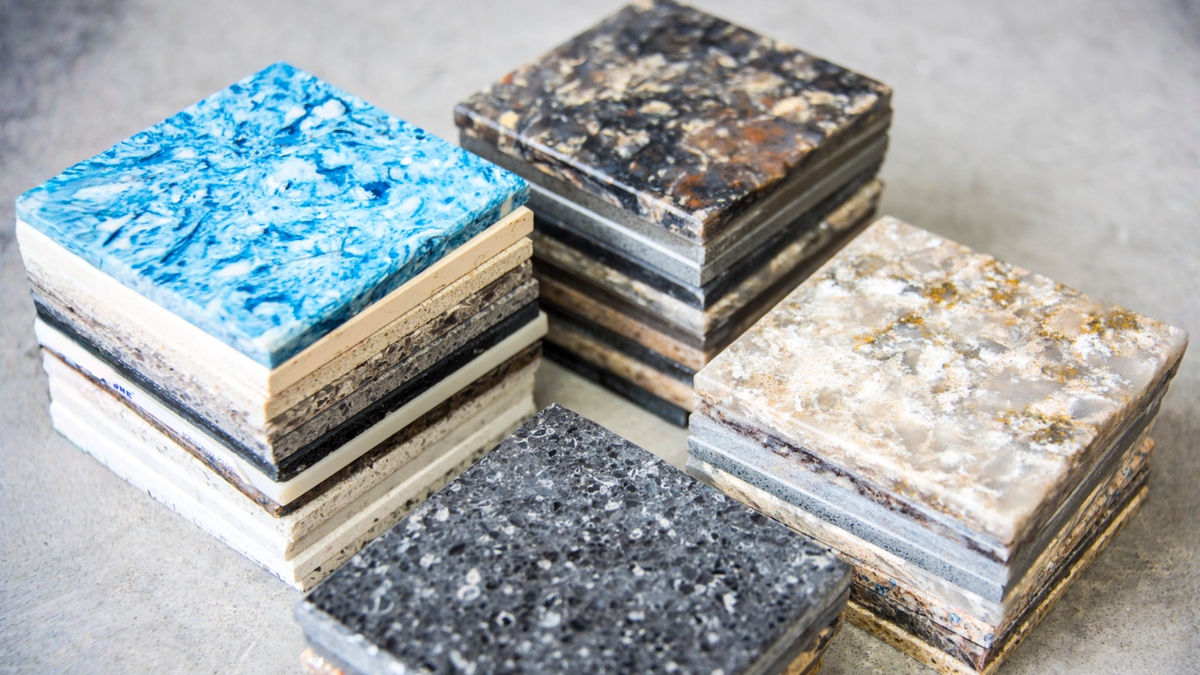
Countertops are one of those decisions that feel bigger than they should, mostly because they’re expensive to change your mind about later. Once a slab is cut, fabricated, and installed, you’re living with it for a long time — which is exactly why so many people freeze up in the stone yard staring at samples that all start to look the same after twenty minutes.
The good news is that the decision usually comes down to a handful of real trade-offs, not endless options. Here’s an honest breakdown of the four materials that come up again and again, and how to think about which one actually fits the way you live.
Quartz: The Low-Maintenance Favorite
Quartz isn’t natural stone — it’s an engineered material made from ground quartz crystals bound with resin, which is exactly why it’s become the default choice for so many kitchens. That manufacturing process means color and pattern are consistent slab to slab, so what you see in the showroom is basically what you get installed.
The big appeal is maintenance. Quartz doesn’t need sealing, resists staining better than most natural stone, and holds up well to daily kitchen abuse — wine, tomato sauce, lemon juice, the stuff that actually happens in a working kitchen. The trade-off is character. Because it’s manufactured, quartz can look slightly more uniform than natural stone, though higher-end lines have gotten very good at mimicking marble veining if that’s the look you’re after.
Best for: households that want a busy kitchen to still look good with minimal upkeep, or anyone nervous about staining and etching.
Marble: Unmatched Beauty, Real Upkeep
Marble is the material people fall in love with at first sight — the veining is genuinely one of a kind, and no two slabs are ever quite the same. It’s the classic choice for a reason; there’s a softness and depth to natural marble that engineered materials still haven’t fully replicated.
The honest trade-off is that marble is porous and reactive. It etches when acidic liquids sit on it too long — lemon juice, vinegar, wine — leaving dull marks that become part of the counter’s character over time, whether you want that patina or not. It also needs to be sealed periodically. For some homeowners, that lived-in aging is exactly the appeal. For others, it’s a maintenance commitment they didn’t fully sign up for.
Best for: homeowners who love the look enough to accept some patina over time, or kitchens that see lighter daily use.
Granite: The Durable Natural-Stone Option
Granite sits in an interesting middle ground — it’s natural stone, so you get real variation and depth, but it’s significantly harder and less porous than marble, which makes it far more forgiving day to day. It resists heat well, holds up to scratching, and doesn’t etch from acidic spills the way marble does.
Granite’s reputation took a hit for a while when it became almost overused in the 2000s, showing up in speckled patterns in nearly every kitchen renovation. Modern granite selections look nothing like that era, though — leathered and honed finishes in particular have brought it back as a genuinely elegant option rather than a default.
Best for: homeowners who want the depth of natural stone with less babying than marble requires.
Quartzite: The Quiet Powerhouse
Quartzite gets confused with quartz constantly, but they’re almost opposites. Quartzite is a natural stone, formed from sandstone under intense heat and pressure, and it’s genuinely one of the hardest countertop materials available — often harder than granite. It also has the kind of natural veining and movement that can look remarkably similar to marble, which is why it’s become popular with people who want that marble aesthetic without quite as much maintenance anxiety.
The catch is that true quartzite can be harder to source and typically costs more than granite or standard quartz. It’s also worth noting that not everything marketed as “quartzite” actually tests as true quartzite — it’s worth asking for documentation if durability is the reason you’re choosing it.
Best for: homeowners who want marble’s look with meaningfully better durability, and are willing to pay for it.
Why Installation Matters as Much as The Material
Whichever material you land on, the countertop is only as good as its fabrication and installation. Seams, edge profiles, and cutouts for sinks or cooktops all require precision — a beautiful slab poorly cut or poorly seamed can look disappointing no matter how good the material itself is. This is where seasoned kitchen contractors earn their value, handling templating, fabrication, and installation with the kind of accuracy that keeps seams nearly invisible and edges properly finished, rather than leaving it to chance with whoever happens to be available.
It’s also worth asking upfront how a contractor handles templating — most reputable ones template on-site after cabinets are installed, rather than working from drawings alone, since even small measurement discrepancies can throw off a fabricated slab.
The Bottom Line
There’s no single “best” countertop material — there’s only the best fit for how you actually cook, clean, and live in your kitchen. If low maintenance matters most, quartz is hard to beat. If you want unmatched natural beauty and don’t mind the upkeep, marble delivers. If you want the character of natural stone with more everyday durability, granite or quartzite both make strong cases. The right choice comes down to being honest about your own habits, not just what looks best in the showroom lighting.
About the Author

Ryan Nelson
I’m an investor, real estate developer, and property manager with hands-on experience in all types of real estate from single family homes up to hundreds of thousands of square feet of commercial real estate. RentalRealEstate is my mission to create the ultimate real estate investor platform for expert resources, reviews and tools. Learn more about my story.